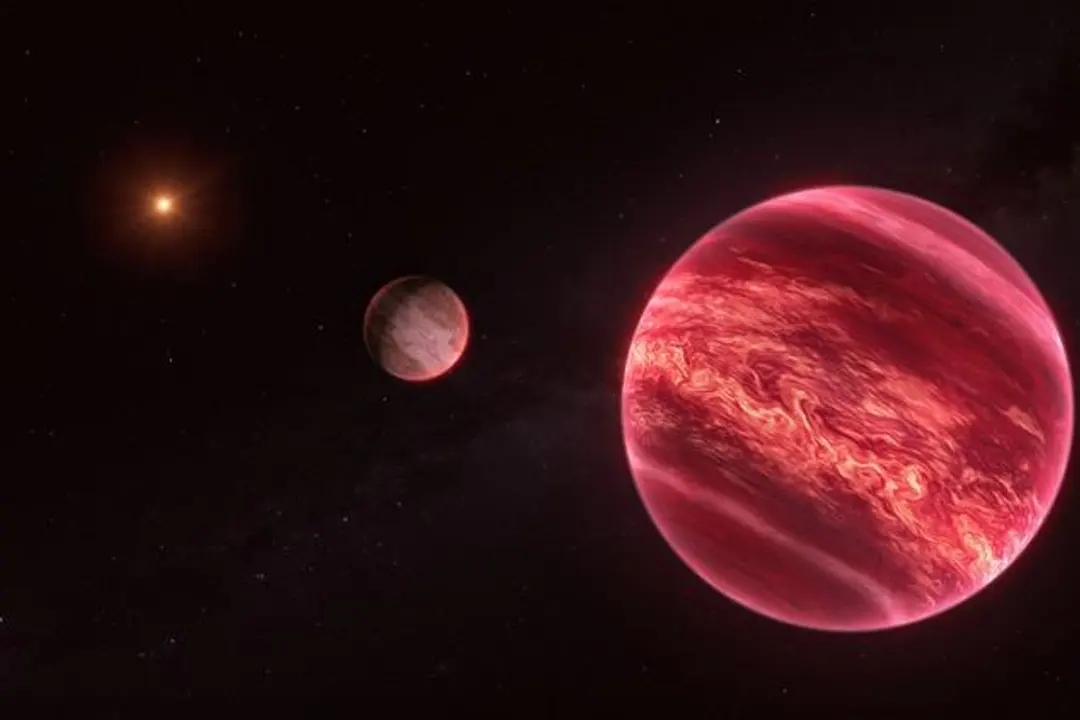
Can there be moons outside our solar system? Astronomers have been asking that question for decades. More than 6,000 exoplanets have been found, but no exomoon has been definitively identified. Now a team led by Kevin Hoy of ESO presents what could be the first case: an object with nearly the mass of Jupiter orbiting… a brown dwarf.
What is an exomoon?
An exomoon is a natural satellite that orbits a world outside our solar system. Until now there were only candidates, with limited evidence and no confirmation. That’s why this finding, published in Nature and announced on July 22, 2026, drew so much attention.
The discovery: the CD-35 2722 system
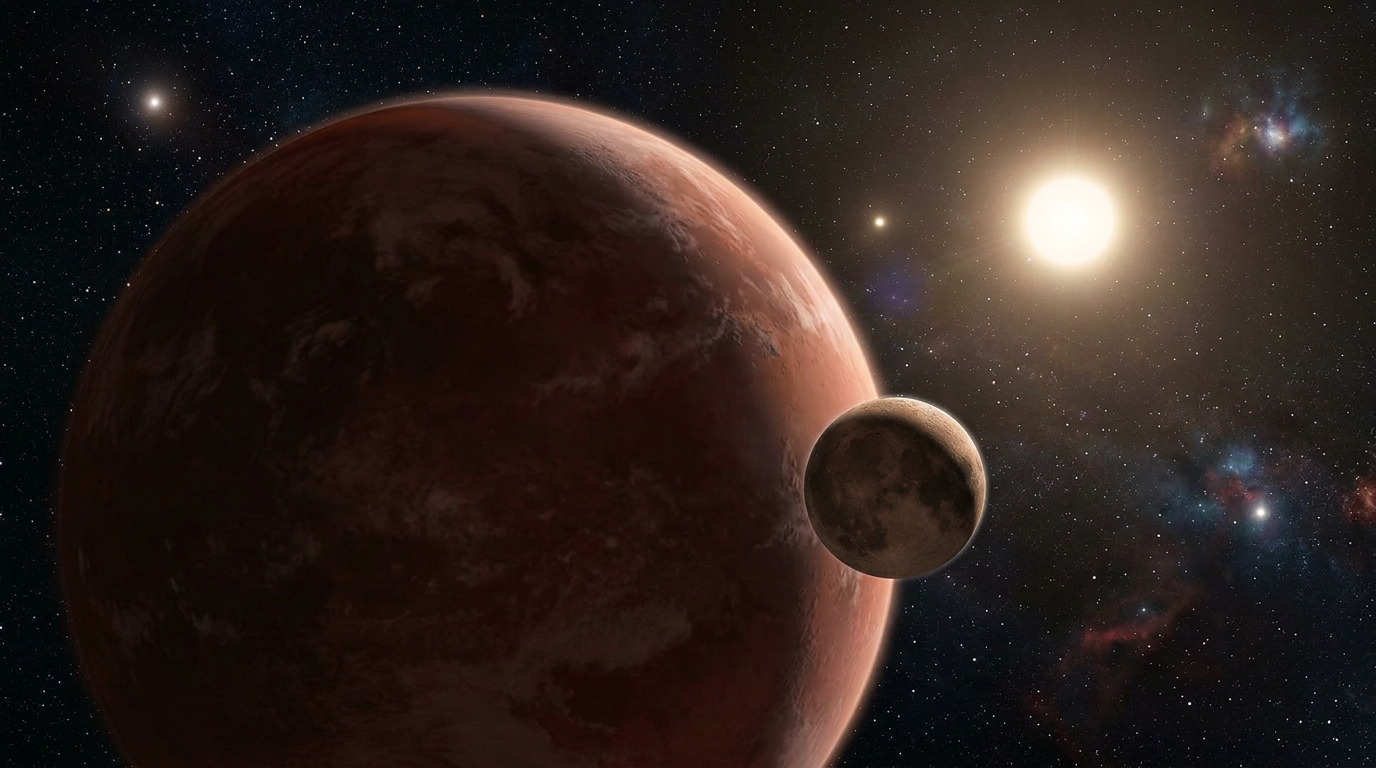
The object sits in the CD-35 2722 system, about 73 light-years from Earth, in the constellation Columba. The system has three levels:
- A star: CD-35 2722 A, a red dwarf with about 0.4 times the mass of the Sun.
- A brown dwarf: CD-35 2722 B, with roughly 30 times the mass of Jupiter. It’s too heavy to be a planet and too light to ignite fusion like a star.
- A new object: an exosatellite with a minimum mass of about 0.9 Jupiter masses, orbiting the brown dwarf (not the star) roughly every 170 days.
How was it detected?
Astronomers never saw it directly. They used the CRIRES+ spectrograph on the Very Large Telescope (VLT) in Chile to monitor the brown dwarf between October 2023 and February 2026. Using the radial velocity technique, the same one that led to the discovery of the first exoplanet around a Sun-like star, they measured the tiny wobble that an unseen companion causes in the brown dwarf’s light.
Is it really a moon?
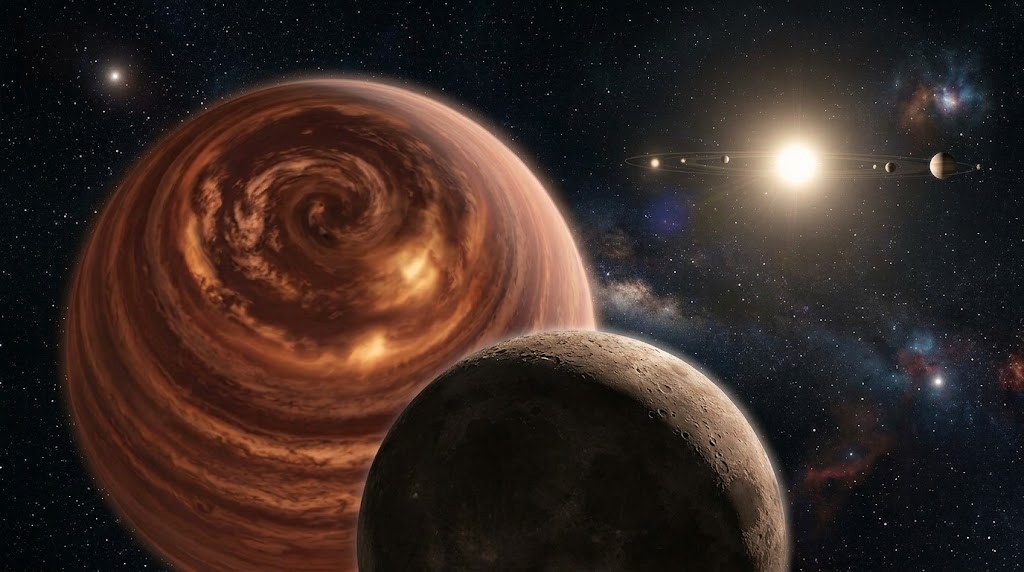
That’s the debate. When there’s a star, a companion, and a third object orbiting that companion, the third object can be called an exosatellite. If it orbits an exoplanet, it’s called an exomoon. But the authors themselves acknowledge it’s unclear whether a satellite orbiting a brown dwarf should be called an exomoon.
According to ESO, this is the first plausible detection of an exosatellite. And the lead author puts his confidence in the detection at around 90%, according to the SETI Institute. It’s a serious result, but still not a definitive confirmation.
Watch the short on our channel
👉 https://youtube.com/shorts/oknhNwe2QSs
Sources
- Hoy, K., Zurlo, A., Peña R, P.A. et al. Planetary-mass exosatellite detected around the substellar companion of a star. Nature 655, 865-869 (2026): https://www.nature.com/articles/s41586-026-10751-w
- ESO press release (eso2610): https://www.eso.org/public/news/eso2610/
- Eos: https://eos.org/research-and-developments/scientists-might-have-detected-the-first-moon-outside-our-solar-system-it-just-depends-how-you-define-moon
- SETI Institute, “Is This the First Exomoon”: https://www.seti.org/news/is-this-the-first-exomoon/