Parents know the thrill of a baby’s first ultrasound: that blurry image where you can finally make out someone growing inside. Astronomers have just achieved the planetary equivalent: an “ultrasound” of two twin planets that are still forming, and it’s the clearest one taken so far.
The setting
WISPIT 2 is a binary star, meaning two stars orbiting each other, located about 437 light-years from us. It’s around 5.4 million years old. That sounds like a lot, but our Sun is 4.6 billion, so next to it, WISPIT 2 is a newborn. If the Sun is a middle-aged adult, this star is only just learning to open its eyes.
The star is surrounded by a protoplanetary disk: a gigantic envelope of gas and dust that works like a cosmic womb. Planets are born from this material, and inside this disk two are growing: WISPIT 2b and WISPIT 2c.
The camera
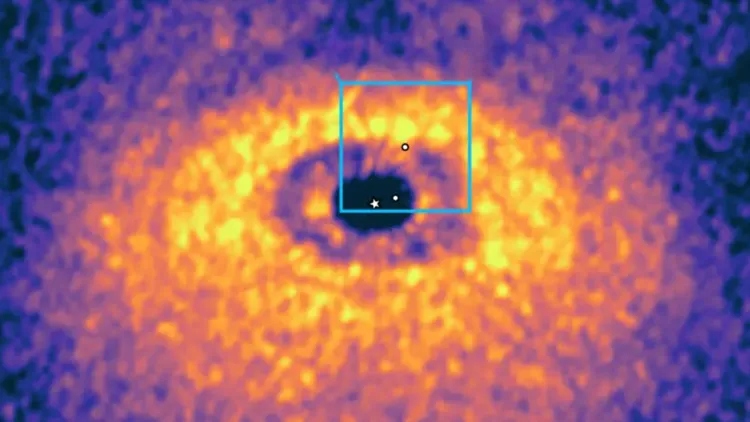
The image was captured by ALMA, the Atacama Large Millimeter/submillimeter Array, a set of 66 radio antennas in Chile’s Atacama Desert. It doesn’t take photos like an ordinary camera: it detects radio waves from cold gas and dust, revealing structures that ordinary light can’t show. The published images are in false color and show a ring and a dark hollow at the center of the disk.
What the image shows
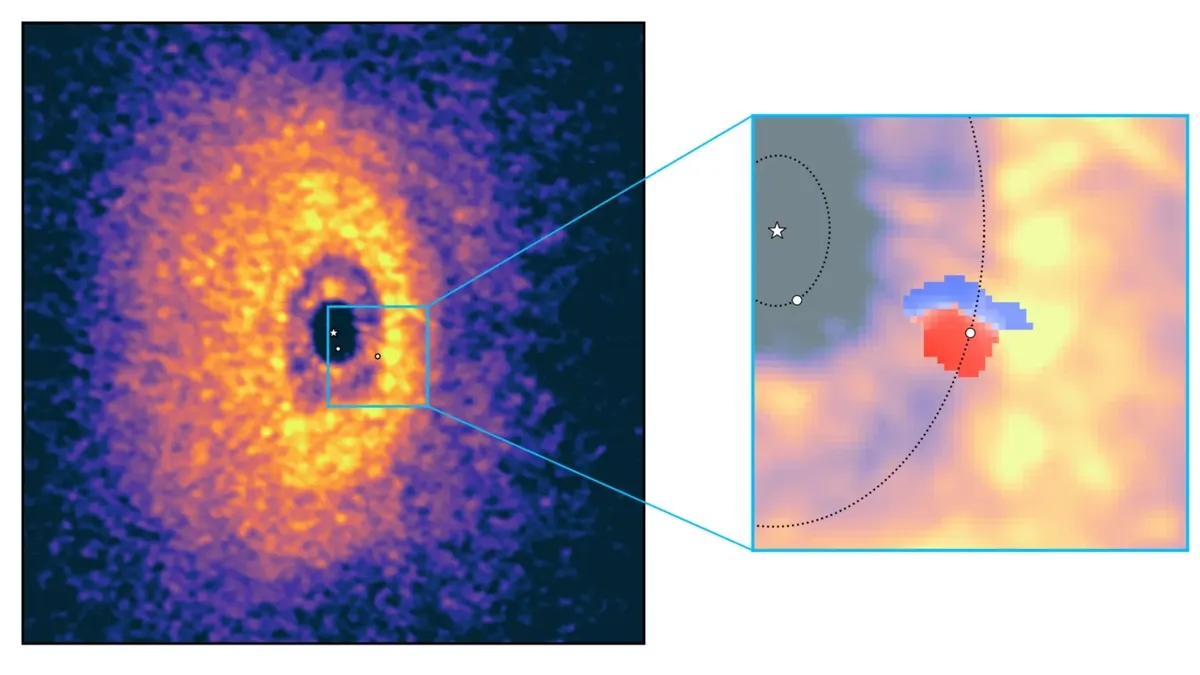
- WISPIT 2b is already a gas giant with five times the mass of Jupiter. As it orbits, it clears a channel in the disk while gathering material to keep growing. It’s like a kid eating everything on their plate.
- WISPIT 2c is a bit behind in its development, but it also leaves its mark: it has carved out a cavity in the disk.
- Around WISPIT 2b there are swirls of gas that computer simulations had predicted but that had never actually been seen. As Myriam Benisty of the Max Planck Institute in Germany put it: now there is an image of them.
Why is it so special?
WISPIT 2b is the only protoplanet where astronomers can see four key elements of planet formation at once:
- The protoplanetary disk.
- The planet itself.
- Evidence that it’s still gathering material.
- The gas interacting directly with the planet.
Together, these four elements amount to watching planet formation in action. Other young systems, like PDS 70, had shown some of these pieces, but never all at the same time.
The surprising part
WISPIT 2b is gathering material at 57 times the Earth-Sun distance, almost twice the distance of Neptune from our Sun. That’s a wider orbit than almost any other known exoplanet. In other words, this baby planet is growing on the outskirts of its system, far from home.
What’s next?
Stefano Facchini, who led the team at the University of Milan, hopes these observations will serve a very practical purpose: teaching astronomers to tell apart the disk features that reveal a protoplanet from those that don’t. That could help find forming planets in many other systems.
The techniques used will also be key for the next generation of telescopes: upgrades to ALMA and the Extremely Large Telescope (ELT), under construction in the Atacama region of northern Chile. Both could give us an even more detailed picture of WISPIT 2 and how its planets sculpt their surroundings.
Sources
- Main article: Space.com, “Astronomers have produced the clearest exoplanet ‘ultrasound’ to date and its twins!”, by Robert Lea, September 30, 2026.
https://www.space.com/astronomy/exoplanets/astronomers-have-produced-the-clearest-exoplanet-ultrasound-to-date-and-its-twins - Official press release: Max Planck Society (MPG), quoting Myriam Benisty and Stefano Facchini.
https://www.mpg.de/26990768/astronomers-produce-the-first-complete-picture-of-gas-planet-formation-in-action