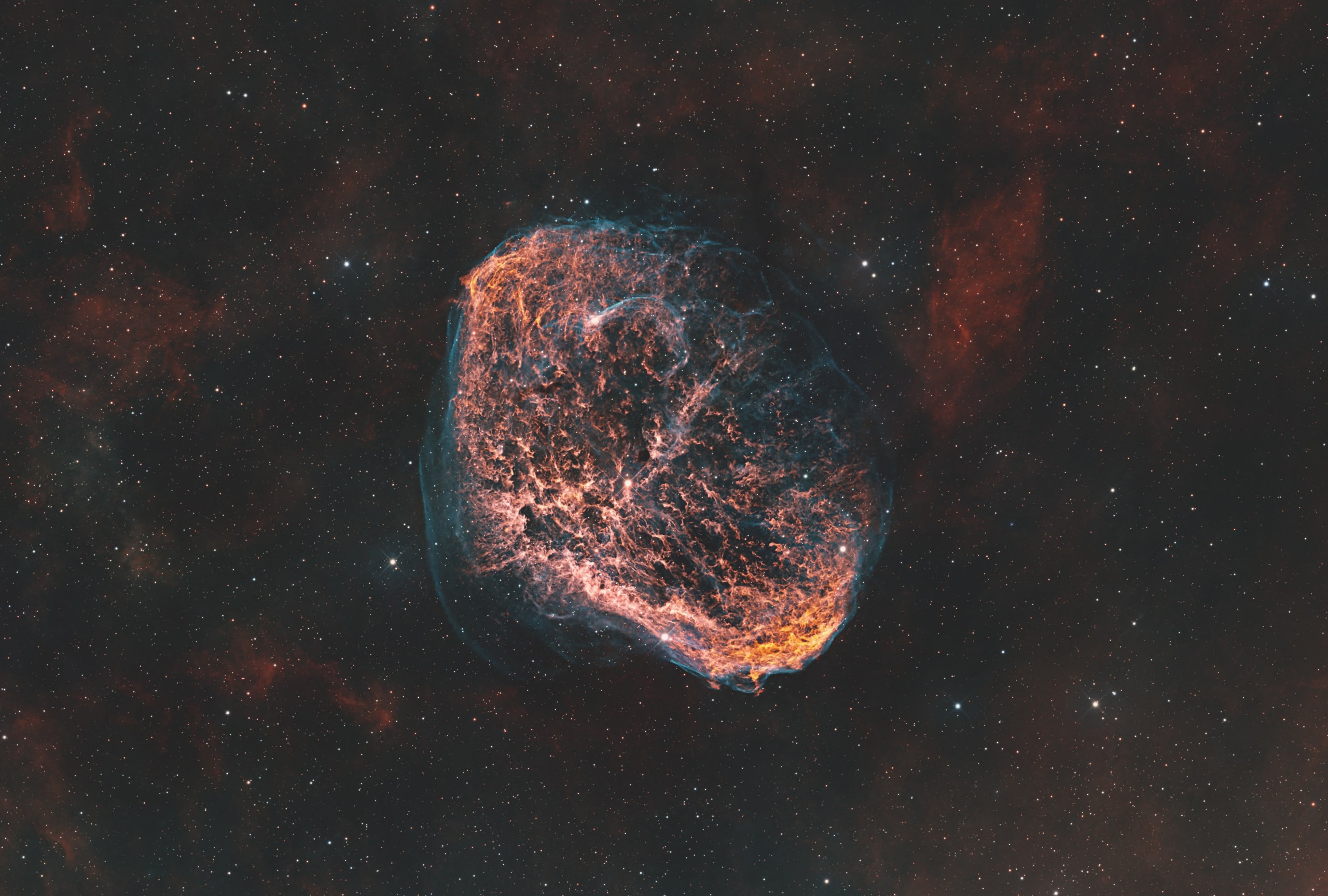
The Crescent Nebula (NGC 6888) is about 5,600 light-years away in Cygnus. Its shape comes from the fast stellar winds of the Wolf-Rayet star at its center, which collide with material the star itself shed earlier in its life. The nebula is a clash between what the star is blowing out today and what it expelled before.
Astrophotographer Aloke Palsikar captured it from Pie Town, New Mexico, using 3 hours of exposure in Hα and OIII filters with a 12-inch f/4.9 astrograph. Those filters explain the orange-red tones (hydrogen) and the blue-green rim (oxygen).
A 2000 NASA APOD, based on Hubble data, put this nebula at about 4,700 light-years away.
The central star, WR 136, will likely explode as a supernova within the next million years.
#CrescentNebula #NGC6888 #Astronomy #Astrophotography #Nebula #WolfRayet #Cygnus #Space #Universe #AstroPhotography #ScienceFacts #DeepSky