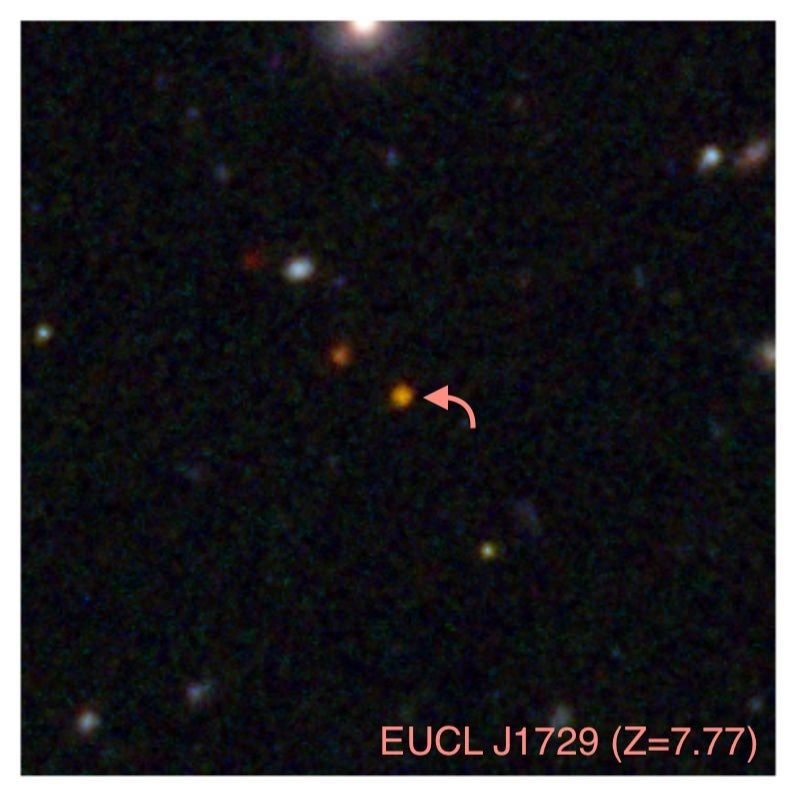
Imagine traveling back to a time when the universe was less than 5% of its current age. Over 13 billion years ago, EUCL J1729 was blazing there: a supermassive black hole so ravenous that its disk of swirling matter outshone entire galaxies. Objects like this are called quasars. Its light left when the cosmos was about 670 million years old, and it is only now reaching our telescopes. It is the most distant quasar ever discovered, beating the previous record, set in 2021, by 15 million years.
What makes this even more striking is how fast it happened. Before Euclid, only 9 quasars this ancient were known, and the first had turned up in 2011. The telescope, which wasn’t even designed as a quasar hunter, found 12 more in just a year and a half of data, as part of a batch of 31 quasars. It can spot objects 10 to 100 times fainter than its predecessors, and it does so using infrared light: the expansion of the universe stretches these objects’ visible light into the infrared.
But the discovery sharpens a problem for scientists: how did a black hole grow so massive in so little time? Every step further back in time makes the question harder. And the hunt continues: Euclid could find even older quasars, out to about 645 million years after the Big Bang, possibly this very year.
#Astronomy #Quasar #BlackHole #Euclid #EUCLJ1729 #EuclidTelescope #Universe #Cosmos #Science #Astrophysics #BigBang #SpaceDiscovery #Space #ESA #SpaceNews