The tiny red dots that are rewriting the history of the Universe
Imagine discovering something so bizarre that even veteran astrophysicists can’t agree on what to call it. That’s exactly what happened the moment the James Webb Space Telescope (JWST) opened its eyes on the cosmos in 2022: thousands of tiny red dots turned up scattered across images of the early universe — and four years later, they’re still upending everything we thought we knew about how galaxies are born.
What exactly are the “little red dots”?
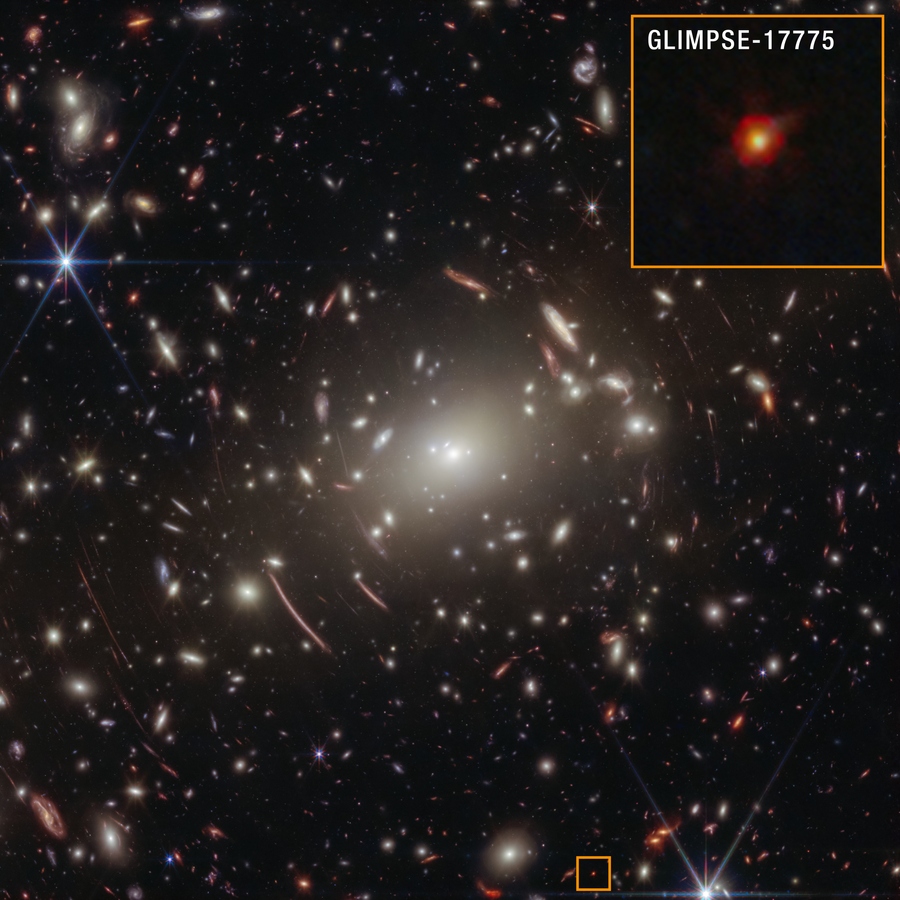
When astronomer Ivo Labbé’s team (Swinburne University of Technology) combed through some of Webb’s first deep-field images, they stumbled on 13 bright red blobs. When they calculated the objects’ mass and distance, the results were staggering: several appeared nearly as massive as the Milky Way, yet existed just 600 million years after the Big Bang. Unsure what to make of the contradiction, astronomers half-jokingly nicknamed them “universe breakers.”
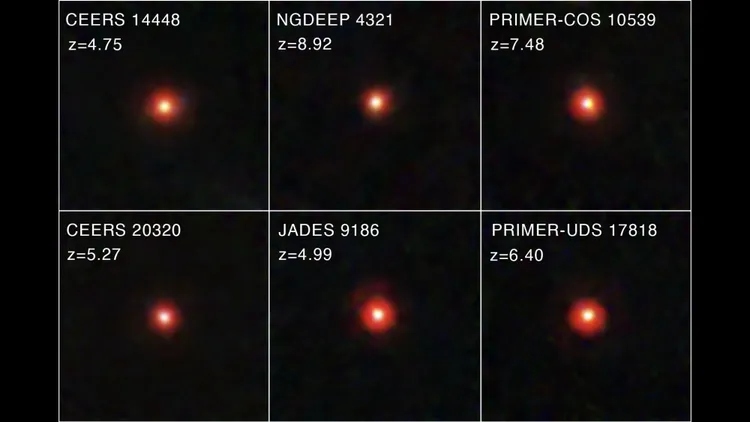
Since then, more than a thousand of these objects have been catalogued, most dating to between 13.2 and 12.2 billion years ago. They glow intensely in infrared, with some ultraviolet light — but strikingly, without the X-rays you’d expect from a typical quasar (the blazing core of a galaxy powered by an actively feeding supermassive black hole).
The strangest hypothesis yet: “black hole stars”
When scientists studied the light spectrum of these dots, they found unusually broadened hydrogen lines — a sign of gas racing around something extremely massive at thousands of kilometers per second. That pointed toward a black hole devouring material. But a “normal” active black hole should flicker in brightness and blast out heavy X-ray radiation, and these objects almost never do either.
The theory gaining the most traction is as strange as it is fascinating: little red dots may be “black hole stars” — colossal clouds of gas, potentially ten thousand times the mass of our Sun, enveloping and concealing a growing supermassive black hole at their center. The black hole feeds from within, like a candle burning inside a tent of gas.
The missing piece: the Saguaro galaxy
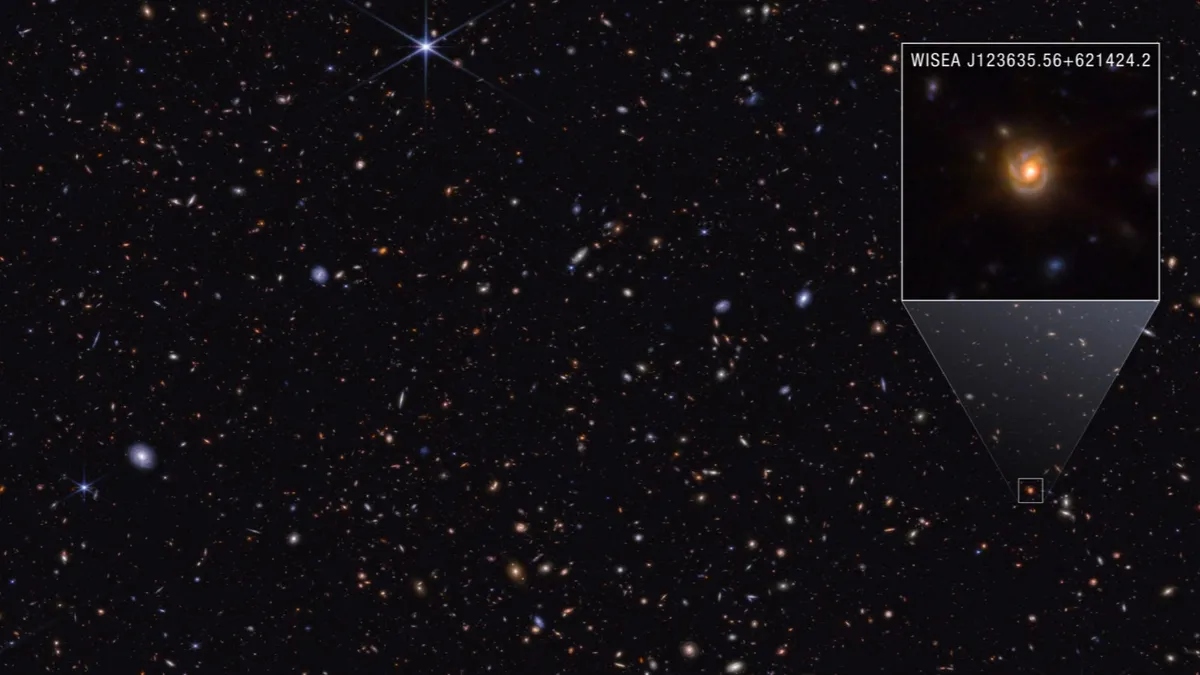
This is where the story takes an exciting turn. A team led by Pierluigi Rinaldi, now at the Space Telescope Science Institute, believes it has found what little red dots eventually become. They identified a spiral galaxy with a strikingly red core, located 10.5 billion light-years away, which they nicknamed “Saguaro” after the red fruit of the cactus native to Arizona’s Sonoran Desert.
Saguaro’s core checks every box of a classic little red dot: it shines in infrared and ultraviolet, but NASA’s Chandra X-ray Observatory also picked up faint X-rays coming from it. According to researcher Carys Gilbert of the University of Cape Town, that mix of an obscured, X-ray-weak active galactic nucleus fits the little red dot puzzle remarkably well.
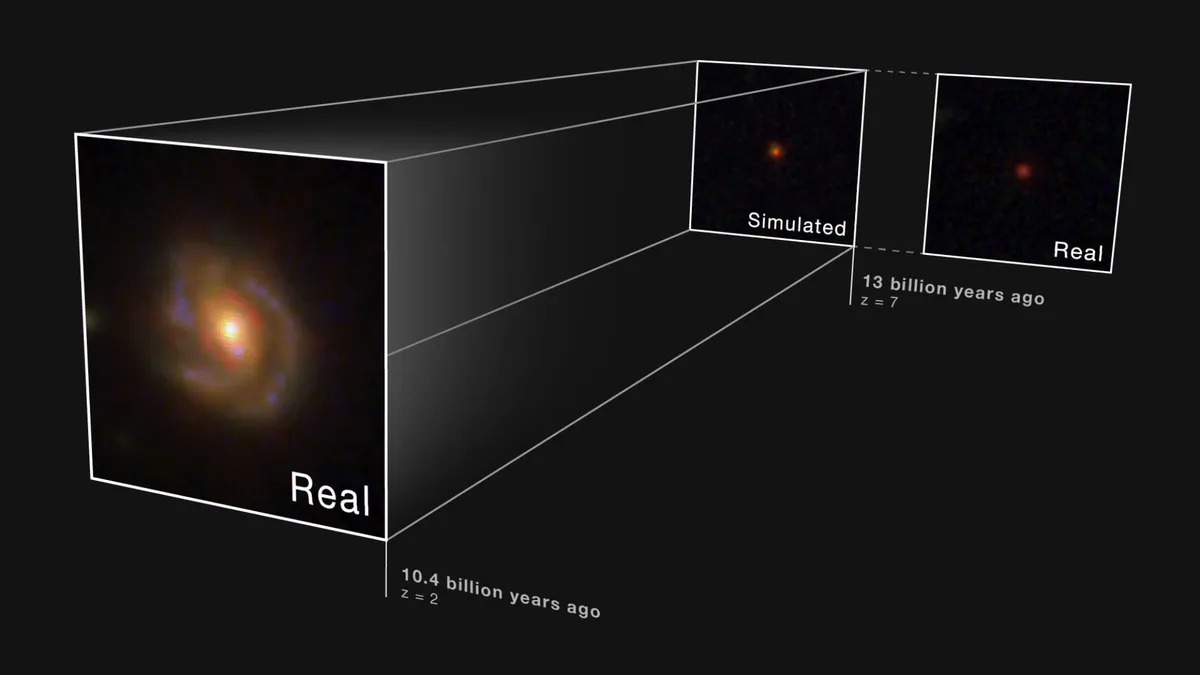
When the team simulated how Saguaro would look if it existed much earlier in cosmic history, the result was striking: it would appear exactly like any other little red dot. In other words, little red dots may not be a distinct class of object at all — just an early phase in the life of galaxies built around supermassive black holes.
Why this matters for anyone who looks up at the sky
The implication is stunning: our own Milky Way may once have been one of these tiny red dots, more than 13 billion years ago. For the first time, astronomers have a solid clue about how these objects grow, transform, and eventually become the mature, star-filled galaxies we see around us today.
Still, the mystery isn’t fully solved. With more than 700 papers published on the topic in just four years — and growing evidence that not all little red dots look alike — scientists are only beginning to connect the first and last chapters of this cosmic story. Webb was built to find the earliest galaxies. It ended up finding something nobody expected: a crucial piece of the puzzle of where we all came from.
Sources: Space.com (Keith Cooper, Aug. 7, 2026) and National Geographic (Liz Kruesi, July 2, 2026)